
Your household devices are key to the most precious commodity in modern energy markets: grid flexibility. Connect, contribute, and earn rewards.

hello@combinder.io
© combinder 2024

If you’ve spent any time in crypto lately, you’ve probably felt the shift: crypto left the “it's just finance” territory - it’s becoming the rails that let anything become a market.
Jesse Walden captured this beautifully in his recent essay “Everything Is Market”: mass participation changes who uses markets, permissionless innovation changes which markets exist, and programmability turns markets into APIs that intelligent agents can consume.
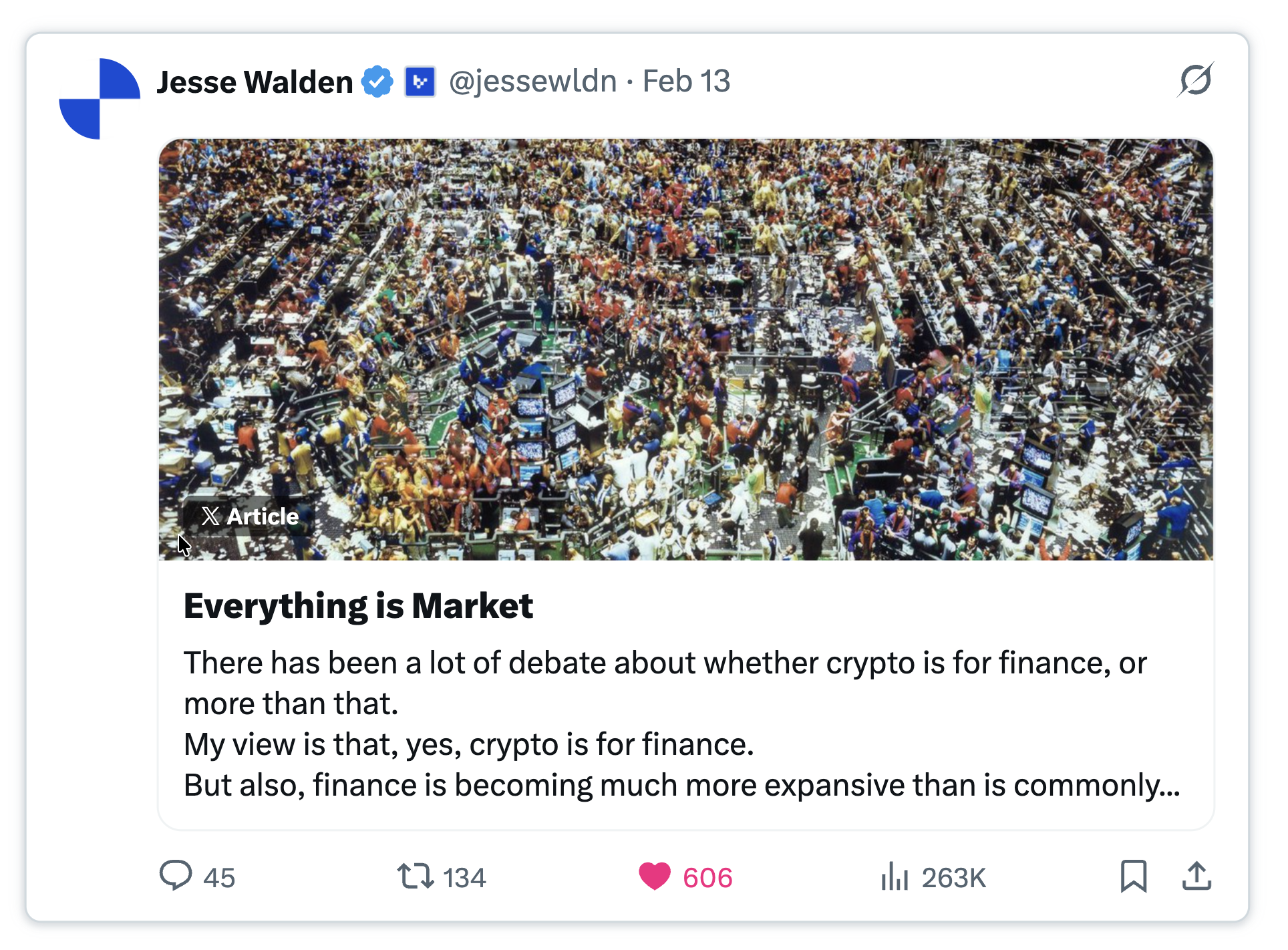
Reading it, we couldn’t stop thinking:
Energy is one of the biggest, most important markets on Earth… and the incumbent players still can’t reach the edge of the grid - neither the balcony solar system, nor private EV chargers, nor your electric heating system.
Electrification is accelerating fast, driven by EVs, heat pumps, rooftop solar, home batteries, smart appliances. But flexibility (the ability to shift when energy is produced, consumed, or stored) is still frustratingly hard to access at consumer scale.
This is mainly because devices are fragmented across vendors and households, integrations are bespoke, slow, and expensive, "Trust” requires heavy measurement & verification and most value flows through incumbents, while households see scraps, if anything.
So even though the flexibility is physically there, the market can’t reliably “see” it, price it, and let alone dispatch it.
Walden’s main point is that it's more about how markets expand rather than if they will expand. In the "everything is market" world Jesse describes, more people will participate directly at markets, permissionless systems create new markets in every parts of life and markets transform into endpoints (APIs) that products/agentscan call. They become programmable.
Applied that to energy this means:
In short: flexibility becomes a programmable commodity.
And once it’s programmable, it can move from “special project” to invisible infrastructure, embedded inside energy products people already use.
From birds eye view, Combinder is a community-driven network that turns everyday devices into active participants in the energy market.
To be more precise, Combinder turns flexibility into a standardized market object that energy services (and agents) can simply call. In the architecture we painted in the Combinder Token Vision this object is called 'Flex Pool'. The outcome is a "Flexibility as an API" Layer (the “quote me a kW in 200ms” layer).
Example market endpoints exposed to the agentic trader of tomorrow:
getFlexQuote (device_id, window, constraints) for available kW / kWh + confidencereserveFlex (capacity, window) for reservation + settlement termsdispatch (signal) to execute + verify performance
Now, if you want markets at the edge, you run into the hardest problem in infrastructure: the cold start. You need supply density before buyers fully trust the product, but you need demand before supply shows up at scale.
Vote-escrow systems were built to solve exactly this problem in DeFi: coordinate growth, route incentives, and create competition around real demand.
In Combinder’s token vision, $VGRD is a coordination and incentive instrument that directs emissions (via ve-governance) to the Flex Pools that matter most, scores rewards (availability, response time, data quality, etc.) and makes sure emissions stay tethered to real flexibility demand over time.
.png)
The long-term goal is a transition from token bootstrapping to incentives that are heavily revenue-backed, to turn “a network of devices” into a market that can scale.
Jesse highlights that markets are becoming APIs that intelligent agents can use and from what we observe and build Energy is heading the same way.
Therefore Combinder is agent-ready by construction, including machine-readable demand signals (time windows, budgets, required capacity), standardized Flex Pools (device × location × epoch), verifiable performance outputs (reputation + settlement based on measurement) and deterministic conflict resolution when multiple requests target the same device/time window (maximize household value under user constraints).
What will seem like “AI magic” at the UI is just clean primitives, clear constraints, and real-world settlement and at the end also the only way make flexibility safe to automate.
The path is straightforward:
1) Wedge into existing flexibility demand
Start with programs and regions where buyers already pay for dispatchable flexibility and where a single device type can create reliable pools (current winner seems to be DACH region in our case)
2) Low/no friction to bootstrap supply density
Make onboarding easy (data-first participation), then graduate users into market participation as reputation builds.
3) Prove reliability, then productize as an API
Don't be afraid to start on a bespoke solution for the first 1-3 flex pools. Once buyers can rely on it, Flex Pools stop being “a pilot” and become infrastructure, ie. something smart energy services can call.
4) Scale by cloning the template
New device types. New regions. New pools. Demand pulls supply.
In sum, this is how we can see “everything becomes market” turning into tangible, virtual grid built by consumers/pro-sumers.
In the most successful cases infrastructure becomes invisible. And this must be our goal here too. Users don’t want to “trade energy”, they want comfort, autonomy and self-efficacy, meaning the ability to earn from the assets they already own. Energy players want reliability and scale without bespoke integrations. And agents want endpoints they can call.
The end state is an energy network, where flexibility is market-native, programmable, and widely owned.
That’s the world we’re building towards.
The age of the prosumer is just getting started. ⚡️